
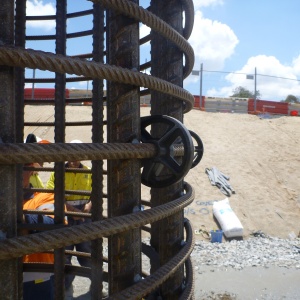
When you're placing rebar cages in drilled shafts, caissons, or piles, getting the cage centered isn't optional — it's structural. Too little cover on one side and you've got a compromised foundation element that inspectors will flag and engineers will reject. The fix is expensive. The prevention is cheap.
Cage spacers and shaft centralizers are the accessories that keep rebar cages properly positioned inside the hole or form. But not all of them work the same way, and choosing the wrong type for your application can cost time and cause headaches at the worst possible moment.
Here's what you need to know to spec the right product before the cage goes in the ground.
Cage spacers — sometimes called shaft centralizers, cage wheels, or rebar cage rollers — attach to the outside of a rebar cage and hold it away from the walls of the drilled shaft, form, or casing. Their job is to maintain a consistent concrete cover around the entire circumference of the cage.
Without them, rebar cages tend to:
Proper cage spacing is a spec requirement on virtually every drilled pier, caisson, or pile job. It's not a nice-to-have.
The most common type for drilled shaft work. A plastic or high-density polyethylene wheel attaches to the outside of the rebar cage — typically clamped or tied to the longitudinal bars — and rolls along the wall of the shaft as the cage is lowered.
Wheel spacers are the go-to choice when:
Wheel-style spacers significantly reduce the friction and binding that can occur during cage installation, making them the preferred option on most drilled pier jobs.
Rigid spacers are fixed-position supports — usually plastic or concrete — that attach to the cage and bear directly against the form or shaft wall. They don't roll, which means they work best in applications where the cage is placed into forms or predrilled holes where smooth installation isn't an issue.
Common applications include:
Rigid spacers are generally less expensive than wheel-style, but they're not appropriate for jobs where the cage has to travel down through a casing or unstable soil.
Used primarily on large-diameter drilled shafts and caissons, spiral centralizers wrap around the cage and provide coverage at multiple points along the height of the cage. They're particularly effective when the cage has significant length relative to its diameter and consistent spacing needs to be maintained along the entire cage.
Spiral styles are less common in everyday work but are specified on some larger commercial and infrastructure jobs where the engineer wants to ensure cover consistency throughout the full depth of the shaft.
Cage spacer sizing is straightforward once you have the right numbers in front of you. You need to know three things:
The spacer protrudes from the cage by:
(Shaft Diameter − Cage Diameter) ÷ 2
For example: a 36-inch diameter shaft with a 30-inch cage needs 3 inches of clearance on each side. If your required cover is 3 inches, you need spacers that extend exactly 3 inches from the outer bars of the cage.
Always check the project specs or structural drawings for the minimum cover requirement — it varies by soil conditions, exposure class, and whether the shaft is in contact with aggressive soils or water. On most projects it ranges from 2 to 4 inches.
The number of spacers — and how they're distributed around the cage and along its length — matters. A single ring of spacers near the top doesn't keep the bottom of a 40-foot cage centered.
General guidelines for drilled shaft work:
When in doubt, more spacers are better than fewer. The cost of additional spacers is trivial compared to the cost of re-drilling a shaft that fails cover inspection.
Concrete cover isn't just a spec box to check. It's what protects rebar from corrosion over the life of the structure. In drilled shafts — which are often in aggressive soils, near groundwater, or bearing critical structural loads — insufficient cover can lead to premature corrosion, section loss, and eventual structural failure.
On the short term, failing cover inspection means core samples, remediation costs, potential re-drilling, and schedule delays. None of those are small problems.
Cage spacers and shaft centralizers are one of the lowest-cost line items on a drilled shaft job. Getting them right is one of the highest-value things a crew can do before concrete placement.
Vista Construction Supply carries cage spacers and shaft centralizers for drilled shaft, caisson, pile, and column applications across California, Nevada, Oregon, and Utah. We stock what ironworkers actually need — and we deliver when you need it, not when it's convenient for us.
If you're not sure which product fits your shaft diameter and cover requirement, talk to us. We've worked the rebar — we can help you spec it right the first time.
Call us at (707) 999-1865 or request a quote at vistaconstructionsupply.com.